


8 min read
Posted
April 14, 2026
at 9:43 AM ADT
Posted by
Click here to visit our new markets resource hub for the latest on the evolving trade landscape
Answer a few quick questions about your business and we'll direct you to incentives, programs, and services you may be eligible for.

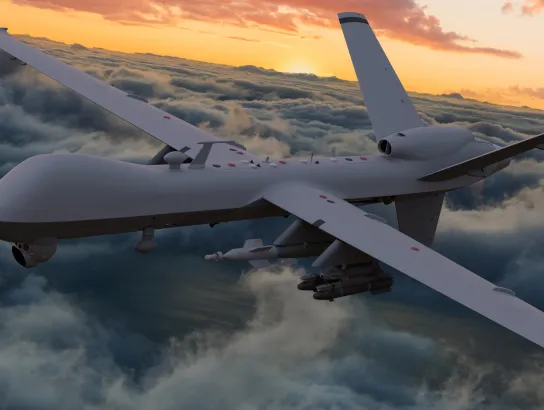
Modern autonomous systems represent the frontier of some of the world’s most advanced technologies. Nations and industry are paying close attention to the successes and vulnerabilities in real-world operations.
In my work with defence companies and partners, I understand how autonomous tools are increasingly used on battlefields. For those using autonomous tools, progress comes down to how quickly countries can adapt to changing conditions in the field. This requires agile ecosystems, where end-users and innovators are tightly connected, and observations are translated into improvements through a rapid closed-loop cycle.
With access to testing environments across land and sea, military weapons ranges, low-traffic airspace spanning coastal and offshore corridors, and airspace already being groomed for autonomy by the Air Force and Transport Canada, Nova Scotia enables companies to validate advanced systems in complex, real-world operating conditions - well beyond what’s possible in a controlled lab setting.
This is what differentiates Nova Scotia. These are not simulated environments or controlled test ranges; they reflect the operational realities these systems are built for. That’s why Canada’s MQ-9B SkyGuardian fleet, being adapted for Arctic deployment, is being positioned to operate in environments like Nova Scotia, where performance isn’t assumed, it’s proven under mission-relevant conditions.
The Royal Canadian Air Force has selected 14 Wing Greenwood as one of the primary operating bases for Canada’s fleet of MQ-9B remotely piloted aircraft, produced by General Atomics. Canada’s Remotely Piloted Aircraft System program represents a $2.49 billion investment that will deliver 11 advanced drones, along with ground control stations, training systems, and supporting infrastructure. The fleet will enhance Canada’s intelligence, surveillance, and reconnaissance capabilities both domestically and with allied partners, with initial deliveries expected to begin in 2028.
The program is also expected to generate significant opportunities through industrial and technological benefits (ITB) across training systems, sensor integration, software platforms, data analytics, and long-term sustainment, creating new entry points for companies across the drone ecosystem.
Nova Scotia’s aerospace and defence ecosystem is not just established; it’s already actively supporting the development, testing, and deployment of advanced drone technologies in real-world defence environments.
In southwest Nova Scotia, Yarmouth International Airport provides access to coastal terrain and open ocean. Here, companies move beyond basic flight testing into operational validation, where systems must perform reliably across extended distances, variable weather, and complex airspace.
Across the province, coastal, marine, and cold-weather environments support aerial systems used for surveillance, maritime monitoring, and long-range data collection. These environments introduce the stressors, temperature extremes, wind, visibility, and endurance demands that directly impact system performance, reliability, and mission readiness.
Halifax is home to Canada’s largest naval base, alongside key national defence research and innovation assets, including the Defence Research and Development Canada Atlantic Research Centre, the Defence Innovation and Security Hub (DISH), and the North American headquarters of the NATO Defence Innovation Accelerator for the North Atlantic (DIANA). The Royal Canadian Navy fleet in Halifax is also expected to integrate seaborne ISTAR (Intelligence, Surveillance, Target Acquisition, and Reconnaissance) uncrewed systems, further advancing operational capabilities at sea.
What differentiates this ecosystem is how closely these organizations operate together. Companies are not working in isolation - they are positioned within a network that connects technology developers directly with defence operators, research partners, and NATO-aligned innovation programs. This proximity accelerates collaboration, shortens development cycles, and creates clearer pathways from concept to deployment.
Equally important is access to top-tier talent in artificial intelligence, software engineering, and cybersecurity, capabilities that are essential not only for building advanced autonomous systems, but for securing, integrating, and scaling them in mission-critical environments.
For international aerospace and defence firms evaluating North American expansion, the challenge is balancing cost, access, and operational complexity. Larger aerospace hubs often offer scale, but come with higher costs, constrained airspace, and longer timelines.
Nova Scotia offers a more efficient alternative. Companies can establish and scale operations without the cost structures, congestion, and regulatory friction found in larger jurisdictions, while maintaining direct access to key defence markets and partners. This translates into several key advantages:
This combination allows companies to move more efficiently, from setup to testing to deployment, while remaining closely connected to North American and global defence markets.
Drone systems will continue to play a growing role in defence and security operations globally. Companies developing these technologies require strong partnerships with industry, government, and defence organizations as they bring new capabilities to market.
At Invest Nova Scotia, I work directly with aerospace and defence firms exploring expansion in the province. I support companies through site selection, market intelligence, introductions to local defence organizations and research partners, navigation of federal and provincial incentives programs, and connections to supply chains and talent pipelines.
Whether establishing a first North American presence or expanding existing operations, Nova Scotia brings together the airspace, regulatory alignment, operational access, and defence partnerships required to develop, validate, and scale advanced drone technologies in one location. These strengths make Nova Scotia an ideal location for developing tomorrow's technology.
Connect with me to explore how Nova Scotia, Canada, can support your strategy.
Sheldon Gillis works with international defence companies to support Canadian expansion, with a focus on investment attraction and growth of defence operations in Nova Scotia.