7 min read
Posted
March 26, 2026
at 9:00 AM ADT
Click here to visit our new markets resource hub for the latest on the evolving trade landscape
Answer a few quick questions about your business and we'll direct you to incentives, programs, and services you may be eligible for.

For decades, mineral exploration has relied heavily on geologists interpreting physical samples extracted from the earth. While drilling generates enormous amounts of geological data, translating that raw material into actionable insight can be slow and costly.
Halifax-based Scient Analytics was founded to change that dynamic by using artificial intelligence and advanced imaging to bring speed and precision to mineral exploration.
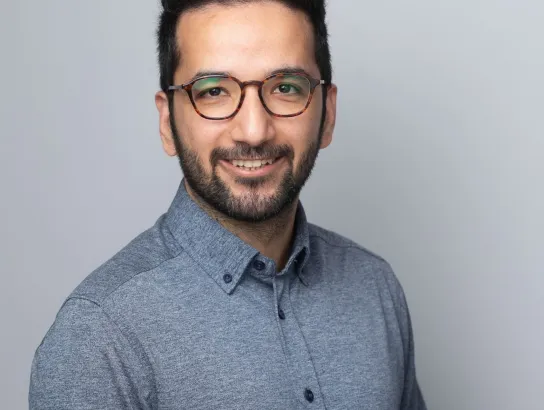
Founder and CEO Masoud Aali traces the origins of the company to a recurring challenge he observed.
“Scient really started as a response to a practical gap I kept seeing while working in research and spending time with geologists in the exploration space.”
Through those conversations, he saw a disconnect between the effort required to generate drill samples and the time it took to convert them into meaningful geological decisions.
“What became clear was that exploration, specially for critical minerals and precious metals, still suffer from long lead time and subjectivity in how quickly and objectively we turn physical samples into decisions. A huge amount of time, money, and effort goes into generating drill core, but the path from drill sample to insight is often slow, manual, and dependent on what can be recognized by the human eye.”
That gap became the starting point for Scient’s approach. Aali believed emerging technologies could help streamline the process if they could be integrated effectively.
“We knew tech could deliver, but the real question was whether combining the imaging analytics and AI would solve the industry problem at scale.”
Nova Scotia quickly became central to the company’s strategy. Beyond being home base, the province offered unique geological and institutional advantages.
“Nova Scotia became the North Star for Scient very early on. This is a small province, but it has remarkable geological diversity and strong potential in critical minerals.”
He also points to the province’s preserved drill core archives as another key asset.
“Nova Scotia has something incredibly valuable that was built through long-term thinking of our predecessors and that’s our provincial public archive of drilling assets. Those preserved drill core collections are a tremendous geological asset for the province and for the country.”
Scient’s founding vision was to unlock more value from that existing resource.
The company combines advanced imaging with AI to analyze drill core samples and detect mineralogical patterns that might otherwise go unnoticed.
But Aali emphasizes that the innovation goes beyond applying AI to geology. It required building a complete workflow that fits how exploration teams actually operate.
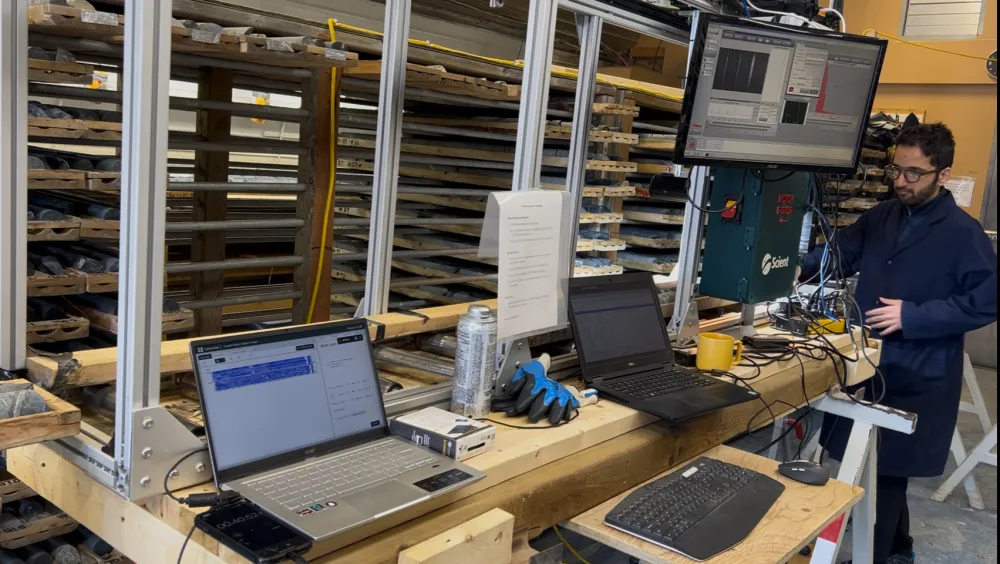
“Scient started first as a software and analytics company, focused on turning large volumes of complex data into geological insight. But over time, we realized that to make this usable in practice, we had to build the full solution end to end: the hardware to acquire the data, the software to process it, and the workflow to turn it into something decision-ready for geologists and operators.”
That integrated system allows exploration teams to capture detailed spectral data from drill core samples, analyze it with machine learning models, and convert the results into actionable geological data.
The result is a more data-driven exploration process and faster time to decision, which allows companies to derisk their exploration investment early and accelerate their assessment for mineral potential.
As the company moved from concept to commercialization, support from Invest Nova Scotia – including participation in the Invest Nova Scotia Accelerate program and as a client at The Bays – played an important role in helping Scient expand beyond its research roots.
“Invest Nova Scotia was instrumental in that journey. They were among the early believers in Scient, but just as importantly, they helped us think beyond technical feasibility and toward commercial viability.”
Since its founding, Scient Analytics has achieved several important milestones, both in technology development and industry collaboration.
“One of the things I’m most proud of is that this work contributed to building the first Canadian virtual core library, made in Nova Scotia.”
For Aali, the project represents more than a technological achievement.
“For me, that was bigger than a company milestone. I see it as a showcase that made-in-Nova-Scotia mining technology could create a foundation that serves the local industry and help attract more investment from outside the province.”
Scient’s growth has also had local economic benefits. Even with a relatively small team, the company contributes to the province’s innovation ecosystem, drawing from the province’s strong technical and scientific workforce.
“We’re proud to build and retain highly skilled talent here in Nova Scotia. Despite being a small team, Scient now contributes to higher-value local jobs and draws from the strong pool of talent. I’m proud that we’ve been able to help keep some of that talent here at home.”
Today, the company has moved beyond early-stage development and is beginning to deploy its technology more widely.
“We’ve worked with the private sector, and we’ve also reached the point where the know-how developed here in Nova Scotia is being transferred internationally.”
That global reach is particularly meaningful to him.
“That matters to me because it means this is not just innovative technology, it is exportable Nova Scotia expertise.”
As Scient prepares for its next stage of growth, including plans to raise a seed round, the company’s long-term vision remains rooted in transforming how mineral exploration is conducted.
Aali believes the company’s technology can help exploration teams identify critical minerals faster while supporting more responsible resource development.
“If I had to summarize the original vision in one sentence, it would be this: if Nova Scotia has a critical mineral, Scient’s technology is able to detect it and help move exploration toward a faster, more data-driven workflow by bringing hard geological insight to the table.”
In an industry where discovery timelines can stretch for years, that shift toward data-driven insight could play a key role in accelerating the search for the minerals that will power the next generation of energy, technology, and infrastructure.