


5 min read
Posted
January 13, 2026
at 9:00 AM AST
Click here to visit our new markets resource hub for the latest on the evolving trade landscape
Answer a few quick questions about your business and we'll direct you to incentives, programs, and services you may be eligible for.

Creating an industrial biotechnology start-up is hard. Really hard.
It requires courage to chase a scientific breakthrough that may have taken years or even decades to emerge from the lab. It takes even more resolve to turn that breakthrough into something that works reliably, at scale, in the real world. Founders must navigate long R&D cycles, technical uncertainty, regulatory complexity, market validation, and slow (often skeptical) customer adoption – all before meaningful revenue ever appears.
But for industrial biotech, there is one factor that underpins all the others: scale-up infrastructure.
Without the physical ability to move from lab-scale experiments to pilot, demonstration, and early commercial production, even the most promising technologies can stall. For industrial biotech companies, scale-up is the make-or-break phase of the journey.
Industrial biotech start-ups are often described as being on the wrong side of the steep cost curve. Early-stage costs are high, timelines are long, and capital intensity increases well before revenues materialize.
Pilot plants, specialized equipment, process optimization, and validation runs require significant upfront investment, often before markets are fully proven or customers are fully committed. This reality clashes with traditional investment models, which tend to favor faster timelines, lower capital requirements, and clearer short-term returns.
The result is a familiar and uncomfortable chicken-and-egg cycle. Founders need access to scale-up infrastructure to prove performance, reduce costs, and demonstrate commercial readiness. But without proven demand and traction, it’s incredibly difficult to raise the capital required to build that infrastructure.
The Verschuren Centre, together with Invest Nova Scotia, recognized both the opportunity in industrial biotech and the systemic barrier holding it back. The response was to flip the traditional model.
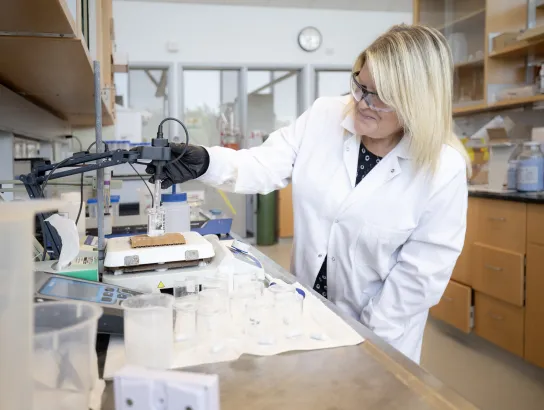
Instead of requiring each company to build its own facilities, they created a world-class, shared scale-up environment. Today, companies participating in AscendBio programming can access pilot-scale fermentation capacity at 100-litre, 1,000-litre, and 10,000-litre scales, supported by downstream processing, advanced analytical laboratories, and a team of experienced industrial biotech scale-up experts.
Just as important, AscendBio pairs technical capability with business support – helping companies de-risk their technology, navigate investment processes, and raise the capital needed to grow.
This shared infrastructure has fundamentally changed the trajectory of industrial biotech in Canada. More than 50 companies have participated in AscendBio to date, gaining the ability to test, optimize, and scale their technologies faster and with more capital-efficiency without bearing the full cost and risk of standalone facilities.
Nova Scotia has taken the next step with the launch of the Neptune BioInnovation Centre, Canada’s first large-scale biomanufacturing hub purpose-built for precision fermentation and industrial biotech.
Neptune is designed to provide industrial-scale fermentation capacity ranging from 25,000 litres to 150,000 litres, along with downstream processing capabilities designed to support commercialization and global competitiveness.
Together, the Verschuren Centre and Neptune BioInnovation create a true scale-up continuum, from pilot through to industrial production – something few regions in the world can offer.
Why Infrastructure Changes Everything
Purpose-built pilot and demonstration facilities lower barriers to entry, reduce capital risk, and dramatically shorten learning cycles. They allow start-ups to test, fail, iterate, succeed, and improve without betting the company on a single, all-or-nothing facility build.
Just as importantly, they give investors and customers tangible proof that a technology can perform beyond the lab. This allows capital to focus on innovation and growth.
Nova Scotia understands the transformative potential of industrial biotech and its ability to reshape the economy. Regions that invest in scale-up infrastructure send a clear signal: they are serious about industrial innovation, committed to long-term value creation, and willing to support companies through the hardest phase of growth.
Too many industrial biotech innovations fail not because the science doesn’t work, but because the ecosystem doesn’t support scale. Infrastructure is how we close that gap and turn breakthrough ideas into world-changing companies.
Nova Scotia is building that ecosystem, and AscendBio companies are proving that with the right support, industrial biotech can scale faster, smarter, and with more capital-efficiency.