


7 min read
Posted
March 10, 2026
at 9:00 AM ADT
Click here to visit our new markets resource hub for the latest on the evolving trade landscape
Answer a few quick questions about your business and we'll direct you to incentives, programs, and services you may be eligible for.

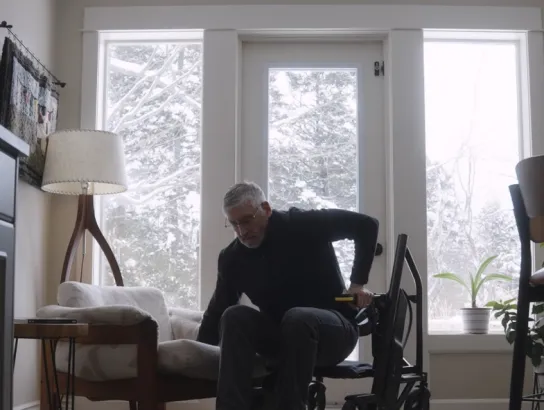
In 2019, what began as a deeply personal family challenge for Axtion co-founder Tracey McGillivray would ultimately evolve into a globally relevant innovation in mobility care.
McGillivray’s father was 82 and beginning to fall more frequently – not because of dramatic accidents, but because of the quiet realities of aging.
“He’d bend over to get something and not be able to get back up. Each incident meant a call to emergency services, as her mother could not safely lift him. There was nothing in the world that could help, especially in a typical home environment.”
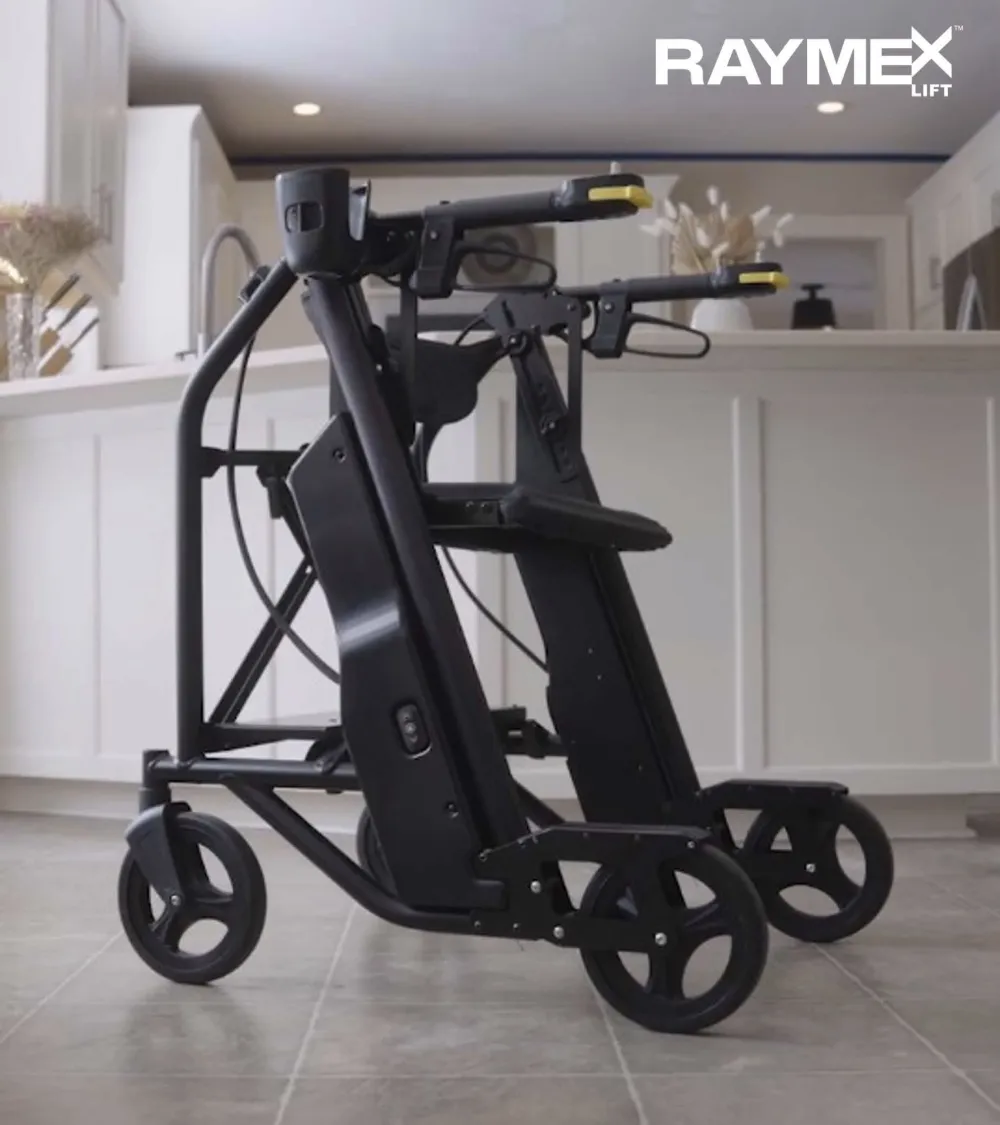
That absence of a practical, dignified solution sparked the creation of Axtion and its flagship product, the RAYMEX® Lift.
For aging individuals who wish to remain at home, the lack of accessible lift solutions often leads to loss of independence or unnecessary hospital visits.
Determined to change that, McGillivray reached out to Liam Maaskant, a mechanical engineering graduate she met through Acadia University. “From the moment we met, I thought, ‘This human being is quite remarkable,’” she says. “I bet you he could do this.”
Maaskant agreed to take on the challenge.
From the outset, the two founders approached the problem methodically. They first developed independent concepts, then compared ideas. Through research and field visits to care homes, Maaskant observed that many potential users already relied on rollator walkers.
From there, the core idea emerged to integrate a powered lifting seat into a rollator-style mobility device.
“Those are mobility devices. They can navigate through a home,” Maaskant explains. “We started seeing what people were able to do while they were on the ground and what restricted them from getting back up. A lifting seat was suitable for a large number of users.”
Prototyping began during the height of the COVID-19 pandemic in a modest Bedford workshop. Early models were built from wood, dismantled car jacks, and power drills.
“Our first prototypes were basically a lead screw off a car jack and some drills,” Maaskant says. “I just stood on a platform and tested different ways to lift myself up.”
Over time, those crude builds evolved into multiple functional prototypes – four in wood and three in metal – before landing on a design that worked. The breakthrough came with a dual motor lead-screw system that could lift a seated user safely and steadily.
“That third one was the sweet spot,” Maaskant recalls.
With support from Dalhousie University’s ideaHUB, Axtion refined the design into a functional prototype that demonstrated the device’s potential.
A key turning point was the introduction to Precise Design Engineering Solutions, a local manufacturer that quickly became a core partner.
“They’ve been able to take what I brought them and really change it into something market-ready,” Maaskant says. “We knew they were going to build the best version of our product.”
Axtion’s early progress was significantly accelerated by programs offered through Invest Nova Scotia and its predecessor, Nova Scotia Business Inc.
“They were the first people to back this through their Productivity and Innovation Voucher Program (PIVP),” McGillivray explains. “While Liam was building, I was writing.”
Through PIVP Tier 1 and Tier 2 funding, Axtion secured support for prototype development, clinical testing, and user validation in collaboration with Dalhousie’s physiotherapy and research teams.
In total, the company accessed PIVP, as well as the Accelerate program and the Export Development Program (EDP).
“That’s been a lot of support from Invest Nova Scotia and it’s all non-dilutive, non-repayable,” McGillivray says. “But now look where we are.”
The programs provided not only financial support, but also mentorship, research partnerships, and access to global markets.
“They saved us millions,” McGillivray says of the early prototyping and validation support. “They drove the discipline early on – prototype early and often, get feedback early and often.”
From day one, Axtion made a deliberate choice to build and scale in Nova Scotia. From university research labs to mentorship networks and community connections, Axtion leveraged a deeply collaborative environment.
“In Nova Scotia, if you don’t know somebody, you know somebody who does,” McGillivray says. “That ‘two degrees of separation’ really matters.”
For McGillivray, who has lived and worked around the world, the province offers a unique combination of talent, infrastructure, and economic advantage.
“I’ve done the economic analysis and there isn’t a better place. The capabilities of the people are off the charts. We just don’t always think big enough.”
That mindset is changing. Through Axtion’s growth, the company is helping demonstrate what is possible from a Nova Scotian base.
As the RAYMEX® Lift approached market readiness, Axtion began testing international demand. Through EDP support, the company attended the world’s largest medical device expos and began building export relationships.
Momentum accelerated dramatically following a featured appearance on Dragon’s Den, where Axtion was selected as the anchor segment for the show’s 20th anniversary season finale.
The response was overwhelming.
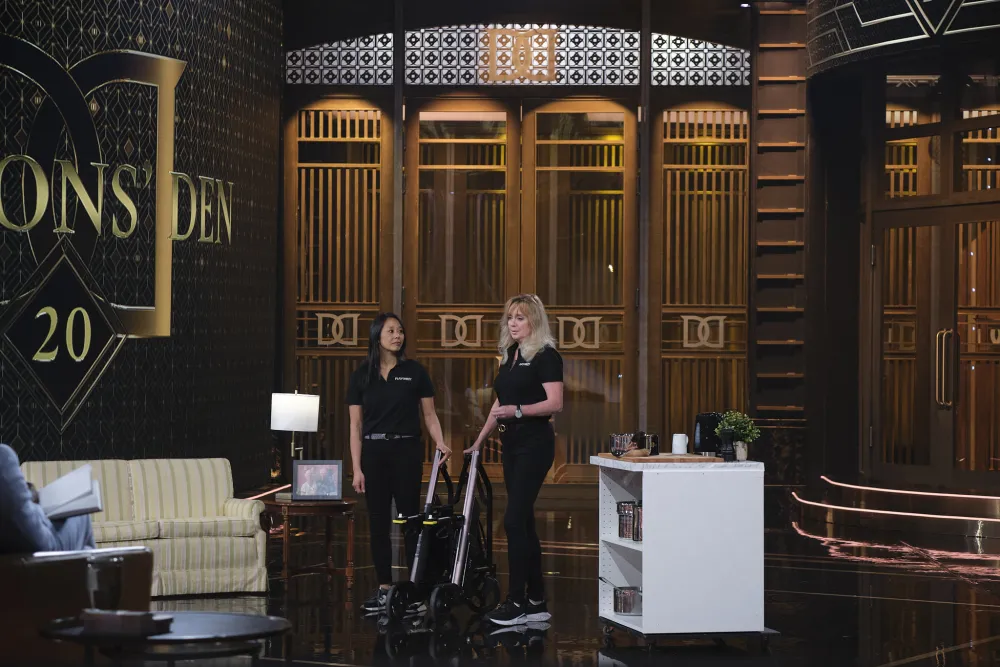
“In seven days, we had over seven and a half million views and over 60,000 visits to our website,” McGillivray says. “There were no links provided – people sought it out on their own.”
Nearly half of that traffic came from the United States, with additional demand from Europe, Australia, and beyond.
“We clearly struck a nerve. This is a massive problem, and people are looking for solutions.”
Over the next five years, Axtion aims to become the global leader in portable lift and transfer devices for home use.
“The RAYMEX® Lift should be the dominant portable mobile lift and transfer aid in the world for home use,” McGillivray says. “And one of the predominant complementary aids in healthcare facilities.”
Longer term, the company plans to expand into additional mobility and aging-in-place solutions, including autonomous features and new product lines.
“Our goal is to become one of the default trusted providers of solutions that help with mobility, aging, and falls prevention.”
For Axtion, success is not just about building a company – it’s about building on an already thriving Nova Scotia ecosystem.
“This is not just us,” McGillivray emphasizes. “This is a Nova Scotian production and it’s going to serve the world.”
Could your business be Nova Scotia’s next success story? Reach out to the Regional Business Advisor nearest you.
UPDATE: In May 2026, Axtion Independence Mobility and the RAYMEX® Lift were named to the Forbes Accessibility 200 List, a global list recognizing the most impactful innovations advancing accessibility across mobility, communication, software, education, and everyday experiences. Even more notably, Axtion was the only company from Nova Scotia and the only organization from Atlantic Canada to be included on the list. Check out the full list here.