


7 min read
Posted
April 21, 2026
at 11:12 AM ADT
Posted by
Click here to visit our new markets resource hub for the latest on the evolving trade landscape
Answer a few quick questions about your business and we'll direct you to incentives, programs, and services you may be eligible for.

Nova Scotia has always been a maritime economy. The rich fisheries of the Atlantic coast have long sustained livelihoods around the province. Lobster remains a key export product. While fishing has declined somewhat in relative importance, marine sectors account for around 13 per cent of the province’s employment and GDP.
As Nova Scotia modernises its economy, and adapts to the chill in Canada’s relations with the US, offshore activities are set to grow even further in importance.
Advertisement The Port of Halifax, where millions of immigrants first set foot on Canadian soil, is vital to Canada’s plans to diversify its trade relations. The port is a “strategic national asset”, says David Thomas, CEO of The Pier, a “living lab” working to facilitate the adoption of new technologies for logistics and supply chain services.
As part of Canada’s efforts to double its non-US exports by 2035, the government announced a C$5bn ($3.6bn) fund in March to modernise trade corridors, including infrastructure around ports. Halifax, the busiest container port in the Atlantic provinces of Canada and their only port capable of handling the largest container vessels, is set to be one of the key beneficiaries.
The importance of the port is highlighted by the decision of port operator PSA, the Canadian National Railway Company and the Halifax Port Authority to establish The Pier. Companies based at the facility are working on a range of technologies to help achieve incremental improvements to efficiency, resilience and sustainability.
“We see the port very much positioned for growth,” says Thomas. “And the innovation work that we do is to try and not just be that competitive solution today, but into the future.”
Another key offshore focus for Nova Scotia is energy. An offshore oil and gas licensing round is currently in progress, and the provincial government has ambitious plans for offshore wind. Its “Wind West” vision (so-called because much of the electricity generated will be exported westwards) envisages up to 62 gigawatts of capacity. As a first step, the government is preparing to issue a tender for 5GW later this year.
Elisa Obermann, executive director of industry group Marine Renewables Canada, says the waters off the Atlantic coast of Nova Scotia are a truly vast resource. “It has some of the strongest and most consistent wind speeds in the world,” she says. “And they are untapped.”
She highlights how offshore wind could be a major revenue-earning opportunity for Nova Scotia. The current capacity of the electricity in the province is only 2.7GW, meaning offshore wind farms have the potential to export huge amounts of surplus power.
As well as supplying electricity to other Canadian provinces, Nova Scotia signed a memorandum of understanding with Massachusetts in February to explore collaboration. Having had its own offshore wind plans thrown out by the Trump administration, the New England state now hopes to import wind-generated power from Nova Scotia.
The key to exploiting these opportunities, says Obermann, is to invest in transmission infrastructure so that wind developers can be confident that a route to market exists.
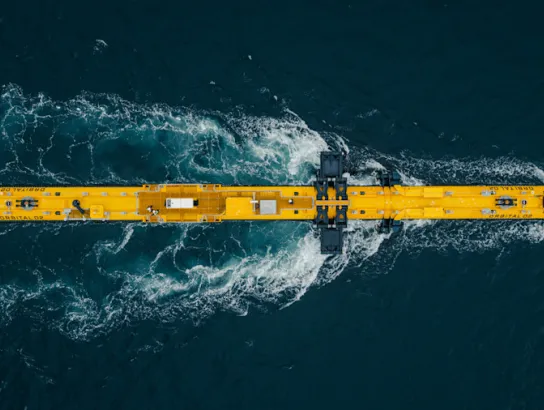
Besides, the Bay of Fundy on the west coast of Nova Scotia has the world’s greatest tidal range. This makes it an ideal location to generate power from turbines powered by rising and falling tides. In theory, up to 7GW of electricity could be generated at the site; and, unlike solar or wind, tidal turbines can supply dependable, baseload power.
Scottish company Orbital Marine Power and its local partner Eauclaire Tidal received four new licences in November 2025 to generate 12.5MW of electricity from five turbines that will be installed at the Fundy Ocean Research Centre for Energy. The two companies now have licences to generate 15MW in total.
Chris Milne, chief financial officer at Orbital, says the authorities in Nova Scotia have been “very open for business and very keen to actually see things happen”.
As a nascent technology, tidal power remains significantly more expensive than the alternatives. However, Milne welcomes the fact that Orbital and Eauclaire were awarded licences for all the capacity offered in the November 2025 auction, a decision that will significantly improve economies of scale in construction and financing.
Milne also gives the Nova Scotia authorities credit for taking factors other than cost into account when awarding the licences, an approach that he says will help “give the highest level of confidence of success”. This is in contrast to the UK’s Contracts for Difference scheme for tidal power, which is focused only on cost factors.
A challenge for tidal power in the Bay of Fundy is assessing its impact on marine life. Previous projects at the site have encountered resistance from federal environmental authorities over concerns of how underwater turbines will affect fish species.
This is where Nova Scotia’s expertise in developing underwater sensing technology could prove helpful.
One of the companies developing fish tracking technology in Nova Scotia is Innovasea. The company has developed a range of solutions, including technology that harnesses acoustic telemetry. Amy Brookman, the company’s general manager for fish tracking, says its technology is being used in the Bay of Fundy to “look at movement patterns of species”.
She adds that the fish tracking part of Innovasea’s business grew out of a project at a local university. The company now employs 180 people in the province. “There’s a great amount of skills available for ocean tech,” says Brookman.
Another leading Nova Scotia ocean tech business is Sensor Global. Though founded in the province, it now does much of its business in Norway, where its sensor technology to monitor fish health is used in the aquaculture sector.
“We have a very unique talent base, I think, in Nova Scotia,” says Sheamus MacDonald, the company’s CEO. The “common understanding” of the ocean economy in the province is key in helping start-ups in the sector to move ahead, he says, noting the accessibility of funding from local investors.
This leads to a simple conclusion for marine tech entrepreneurs. As MacDonald concludes: “Nova Scotia is the place to be.”