


7 min read
Posted
April 21, 2026
at 10:44 AM ADT
Posted by
Click here to visit our new markets resource hub for the latest on the evolving trade landscape
Answer a few quick questions about your business and we'll direct you to incentives, programs, and services you may be eligible for.

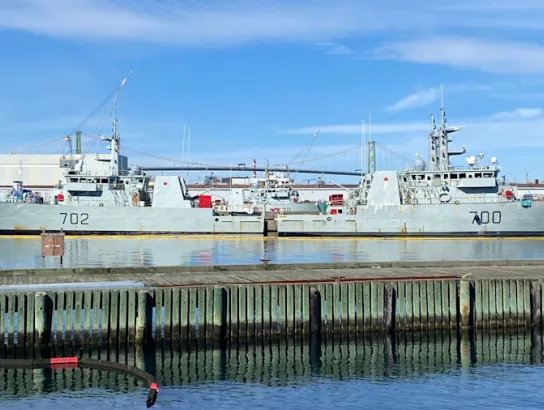
For decades, if not centuries, Nova Scotia’s economic fortunes have been tightly bound to its defence industries.
Canada’s Atlantic fleet uses provincial capital Halifax as its primary base. The Irving Shipbuilding facility on the Halifax shore is the largest manufacturing site for naval vessels in the country. The province is also home to a major air base, and multiple defence and aerospace contractors have local production facilities.
Nova Scotia’s defence sector is now poised for rapid growth, as Canada wakes up from a lengthy period of strategic complacency.
Donald Trump’s repeated jibes about annexing his neighbour, along with his habit of threatening aggressive tariffs, have forced the country to re-evaluate its priorities. Canada now finds itself unwilling to rely on security guarantees from the superpower next door, at a time when Ottawa is warily eyeing possible threats from Russia and China in the Arctic.
In response, the government plans to raise defence spending to 2 per cent of GDP this year, and to 5 per cent by 2035. In February, it unveiled a new Defence Industrial Strategy.
Ottawa’s focus on defence comes at a timely moment for Nova Scotia.
The province achieved steady economic growth between 2021 and 2024 period. That momentum waned, and growth converged towards the national average in 2025 as the whole Canadian economy got caught up in the uncertainty over the future of the USMCA set-up ushered in by the Trump administration and the relationship with its southern neighbour.
Facing slower growth, the provincial government led by conservative Tim Houston, who gained a second mandate in a landslide victory in 2024, is now battling a widening budget deficit and net debt, which has already led to a contentious programme of spending being approved in March.
With less leeway for public investment, private investment, both domestic and foreign, will be key to shoring up growth in the province.
In this context, the defence industry appears well placed to catalyse new investment.
Nova Scotia is home to 13,000 military personnel and 17,000 defence and aerospace workers, while defence generates about C$2.6bn ($1.87bn) per year, or 6 per cent of the province’s GDP, according to figures from the provincial government.
The ramping-up of defence spending therefore provides a unique chance for suppliers to the defence industry to scale up their activities and support Nova Scotia in reviving its economy.
As part of the new Defence Industrial Strategy, the Canadian government is looking to support companies that can deliver both civilian and military technology.
One of these “dual-use” companies is Spiri Robotics, a Nova Scotia-based developer of drone technology. The company currently supports provincial and federal authorities with disaster management and environmental monitoring. Alongside these civilian uses, Spiri increasingly finds its technology is in high demand among defence sector customers.
“Everybody is scrambling,” says CEO Patrick Edwards-Daugherty. “The government wants to invest in new and emerging technologies that have dual-use purpose, drones being one of those areas.”
The focus on dual-use industries is deliberate, he emphasises, noting that the government wants companies to remain viable even in a future where security might be less of a priority.
Ben Garvey, CEO of Enginuity, an engineering consultancy based in Halifax, agrees that the focus on defence and dual-use technology is “very present”.
He likens the situation to the Covid-19 pandemic, during which his company pivoted to focusing solely on developing medical equipment. Now, Garvey says, around 80 per cent of Enginuity’s work is on dual-use equipment, compared with only 15 per cent to 20 per cent a few years ago.
“The only sensible way to do any kind of new product development, new product introduction, is through dual-use,” says Garvey. Defence contracts are notoriously hard to secure, he says. It is much more viable to prove that a technology works in a civilian sphere, before adapting it to military uses.
The limited size of the market in Nova Scotia can be a challenge for companies seeking to scale. Securing finance is far harder for dual-use tech businesses in Nova Scotia, compared with places like Silicon Valley, Garvey says.
Yet there are pockets of the technology ecosystem where Nova Scotia has advantages. Garvey cites the province’s strengths in ocean sensing technology. “Whether you’re listening for blue whales or the mechanical whales that are out there, you’re listening maybe on different frequencies, but with the same technology,” he says.
Kraken Robotics, which is headquartered in Newfoundland but has a major manufacturing facility in Nova Scotia, is an example of a marine sensing player that has been able to achieve significant scale. In March, the company announced the acquisition of a UK-based underwater sensing company in a C$615mn deal.
Kraken’s Nova Scotia base is at Cove, an innovation hub in Dartmouth that provides testing facilities for marine technology companies. Cove is also an accelerator site for Nato’s Defence Innovation Accelerator for the north Atlantic, while in November the Canadian government announced it would host the country’s first Maritime Defence Innovation Secure Hub.
“Integration with Nato and allied networks ensures that businesses can scale quicker connecting to global markets, strengthening national sovereignty and providing allied capabilities,” says Cove CEO Melanie Nadeau.
On the other side of Halifax Harbour, Irving Shipbuilding is working on the Royal Canadian Navy’s River-class destroyers. It finalised a contract for the first three of a planned fleet of 15 vessels in March 2025.
Meanwhile, the focus on defence is extending into the realm of space. In March, the Department of National Defence signed a C$200mn deal to lease a launch pad at Spaceport Nova Scotia, a facility being built by space company Maritime Launch Services.
The province offers a “sweet spot” for a spaceport, says the company’s CEO, Stephen Matier. Being able to launch eastward over the Atlantic improves safety, he adds, while the latitude is more energy-efficient for launching satellites on polar Sun-synchronous orbits compared with equatorial sites.
Along with the Canadian military, Maritime Launch Services has interest from a range of commercial launch clients in using the spaceport, Matier says.
The facility is set to be fully operational by the end of 2027. The beginning of launch operations for both commercial and military satellites will be a symbolic moment for Nova Scotia, signalling that its dual-use industries have truly taken off.